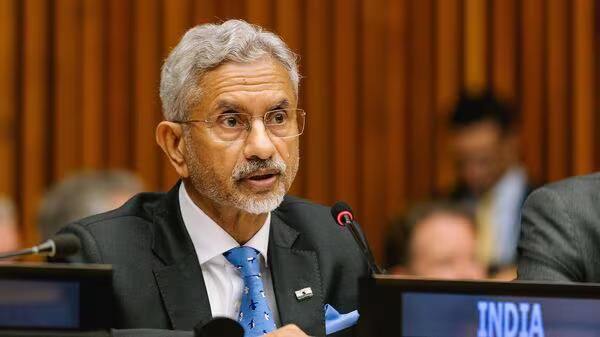
New Delhi: India and three major European nations—Germany, France and Poland—held the inaugural India–Weimar format meeting, marking a new diplomatic platform aimed at deepening strategic cooperation amid global uncertainty. The conference brought together German Foreign Minister Johann Wadephul, French Foreign Minister Jean-Noël Barrot, Polish Deputy Prime Minister Radosław Sikorski and India’s External Affairs Minister S Jaishankar.
The first-of-its-kind engagement focused on three core issues shaping the current global order: the war in Ukraine, developments in the Indo-Pacific region, and the future trajectory of India–European Union relations.
A New Framework for India–Europe Engagement
External Affairs Minister S Jaishankar described the India–Weimar format as an important step in strengthening India’s engagement with Europe. He said the initiative reflects both the support of individual EU member states and a collective effort aligned with Brussels.
According to Jaishankar, smaller group formats such as this help reinforce broader strategic objectives as cooperation deepens. He noted that the discussions were candid, detailed and forward-looking, allowing all sides to exchange assessments on complex global challenges.
Ukraine and the Indo-Pacific in a Changing World
Jaishankar underlined that the conversations took place against the backdrop of a world in flux. He said instability in the Indo-Pacific has been unfolding for several years, while Europe is now confronting its own strategic challenges, particularly due to the ongoing war in Ukraine.
He added that beyond regional crises, wider global shifts are underway that could reshape the international order. Despite geographical distance, he stressed the importance of regular dialogue to share perspectives and align responses.
India–EU Ties Seen as a Major Growth Opportunity
Highlighting the long-term potential of India’s partnership with Europe, Jaishankar said relations with the European Union and its member states offer the greatest scope for future growth among India’s major global partnerships. He pointed to significant untapped potential and new areas for cooperation, calling the participation of three influential European partners in the Weimar format both timely and strategic.
He expressed confidence that the framework would help advance efforts to strengthen India–Europe relations, particularly as the world moves toward a multipolar order where cooperation among like-minded partners becomes increasingly important.

Multipolar World Drives Closer Cooperation
Jaishankar noted that global volatility and unpredictability strengthen the case for closer collaboration among countries with shared outlooks. He said this common understanding was the foundation that brought India, Germany, France and Poland together under the new format.
Details of the meeting were also shared by the External Affairs Minister on social media, reflecting India’s emphasis on transparent and proactive diplomacy.
Bilateral Engagements on the Sidelines
Earlier in the day, Jaishankar held a separate meeting with French Foreign Minister Jean-Noël Barrot, where both sides exchanged views on current global developments and discussed ways to deepen bilateral cooperation and India–EU collaboration. He said the bilateral dialogue would support the implementation of the Horizon 2047 Roadmap and generate new ideas for future cooperation.
During his visit, Jaishankar also met Grand Duke Guillaume of Luxembourg and Deputy Prime Minister and Foreign Minister Xavier Bettel. He interacted with members of the Indian community in Luxembourg as part of his outreach.
According to the Ministry of External Affairs, Jaishankar is also scheduled to address the 31st edition of the French Ambassadors’ Conference as Guest of Honour, underlining India’s growing diplomatic engagement with Europe.
The launch of the India–Weimar format signals a concerted effort by India and key European powers to align strategies, manage global risks and expand cooperation in an increasingly complex international landscape.